Balancing Forces 2
Even when the net force is not zero, we can still use a force diagram; the difference is that there will be an unbalanced force and hence an acceleration.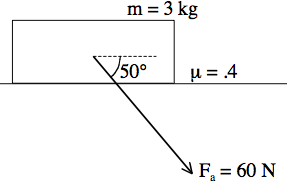
- A brick with a weight of 30 N is sitting on a table. There is a coefficient of friction of .4 between the brick and the table. I exert a force on the brick as shown.
a) On the brick to the left, draw in and label arrows showing all other forces acting on the brick. There should be three more arrows.
b) What is the applied force as a vector?
c) What is the gravity force as a vector?
d) What must the normal force vector be?
(Hint: It doesn't just balance gravity; it has to prevent the brick from going through the table)
e) What is the friction force vector?
(Hint: Friction will balance out the opposing forces if it can, but it cannot grow larger than μFN)
f) What is the net force vector?
g) What is the mass of the brick?
h) What is the acceleration vector?
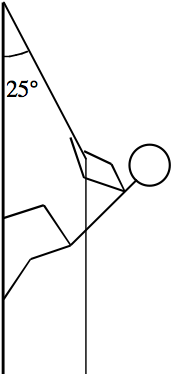
- A mountain climber, descending a cliff, is supported by a rope which makes a 25° angle with the mountainside. The climber has a mass of 64 kg. There is a friction force of 104 N pushing up on him from the cliff. The climber is accelerating downwards at a rate of 1.4 m / s².
a) Draw the force diagram on the picture to the right. You should still draw in and label tension even though the rope is shown, and be careful about what direction  and
and  should point (recall that always points out of a surface and always points along a surface).
b) Give the vector forms of and  .
.
(I told you friction, and you can find weight from mass)


c) What must the net force be?
(No, you can't add up the forces to find this; you only know two of the forces. Use the acceleration.)
d) What is the y component of the tension force?
e) What is the tension force vector?
f) What is the normal force vector?
g) What is the coefficient of friction?
Answers: 1) a)  = (38.6
 - 46.0
  ) N d) = 76 f) 8.2 h)
  = 2.7 m/s²
2) c)  -89.6 N e)
  = (-208 + 446) N (or (-204 + 433) if you use g = 9.8). g) &mu = .5